Author: Constantin Reusberg

  • L’Epée 1839 La Regatta – a vertical skiff in Grand Feu

    L’Epée 1839 La Regatta – a vertical skiff in Grand Feu

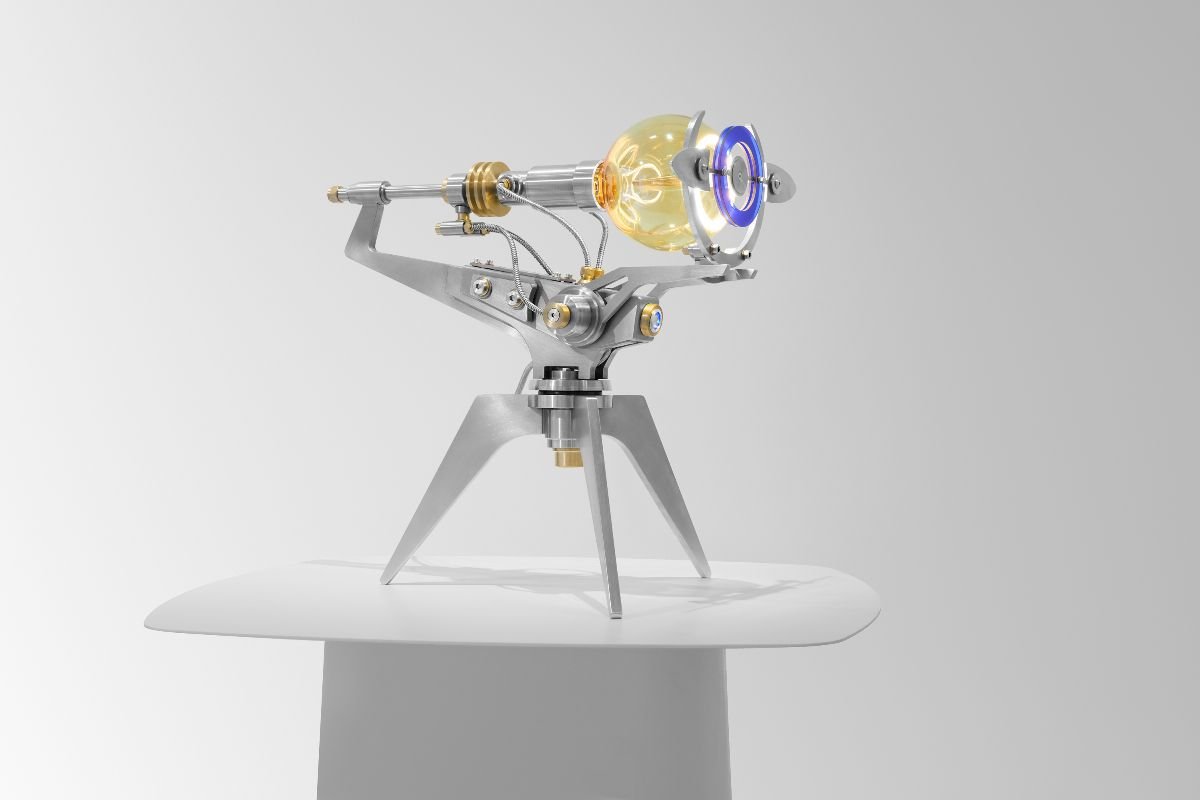
    L’Epée 1839 turns La Regatta into a quiet study of motion, reimagined as one-of-one Métiers d’Art pieces that wear Grand Feu enamel like water on a racing hull. The form is a vertical clock with an elongated silhouette drawn from a skiff cutting cleanly ahead. It is elegant without drama, like a coxless boat that knows exactly where it is going.

    The movement reveals its entire gear train on a single vertical axis. Barrel at one end, escapement at the other, the layout reads like a posture check for rowers. Inside is the in-house caliber with 8 days of power reserve, 2.5 Hz escapement, 26 jewels, and Incabloc protection. Palladium-plated brass and polished stainless steel set a restrained palette, finished across polished, satin brushed, and sandblasted surfaces. Hours and minutes only. Enough said.

    Enamel covers the hull, executed by David Kakabadze Enamel in Tbilisi. The process is deliberately slow: layers of colored vitreous enamel are built up and fired repeatedly at roughly 700 to 750 °C. Each firing deepens tone and luminosity while allowing no easy corrections. The lineage traces to Byzantine and Georgian arts of the 8th century, which suits a clock that prizes rhythm over haste.

    Three interpretations sketch different waters. La Regatta Umi – Sea in Japanese – uses cloisonné with paillons. Ultra-fine gold wires draw the waves, while thin silver leaves under transparent enamel catch light like spray. The reference to Hokusai is clear, but the voice remains the clock’s own. La Regatta Blue Horizon returns to minimalism through flinqué, where guilloché lies beneath translucent blue and shifts gently with the light. La Regatta Prism turns to plique-à-jour, a lattice of enamel without backing that glows like stained glass, the geometry echoing both mechanical rigor and the sport’s discipline.

    For the curious: cloisonné builds tiny cells with gold wires, each filled shade by shade, often through 12 to 15 firings. The paillons technique places extremely thin silver leaves under transparent enamel to heighten depth and cool brilliance. Flinqué layers translucent enamel over engraved patterns for optical movement. Plique-à-jour suspends enamel within a metal framework and fires it without a solid support, a test where cracking and collapse are constant risks. When it works, the light does the talking.

    Specifications, kept honest: unique piece 1 of 1, customizable on demand. Dimensions 518 mm high, base 120 mm square. Materials palladium-plated brass, stainless steel, aluminium. The skiff elements use enamel on copper with gold wires and silver leaves. A calm object for a fast world, rowing time forward one measured stroke at a time.

  • Blancpain Villeret Calendrier Chinois Traditionnel – Fire Horse 2026

    Blancpain Villeret Calendrier Chinois Traditionnel – Fire Horse 2026

    Blancpain marks the arrival of the Fire Horse with its 2026 Villeret Calendrier Chinois Traditionnel, a limited run of 50 platinum pieces that continues the house’s annual exploration of the Chinese lunisolar calendar in mechanical form.

    The concept remains as thoughtful as ever. The watch presents the traditional Chinese calendar while also displaying the Gregorian date and a moonphase. Blancpain debuted this East-West combination in 2012 and states that it was a world first. According to the brand, this combination remains unique in watchmaking.

    At the heart is calibre 3638, developed in-house over five years. The movement drives one of the most intricate calendar mechanisms, coordinating the Chinese cycles with the familiar solar count. This is the fifteenth interpretation of the series, a steady cadence rather than a sprint.

    Practicality has not been forgotten. Five patented hidden correctors simplify life at the bench and on the wrist – four tucked beneath the lugs and a fifth in the case back at 9 o’clock. No tools are needed, and the case flanks stay clean.

    The dial is salmonrose Grand Feu enamel – calm, legible, and traditional in method. Turning the watch reveals a 22K gold rotor by the Métiers d’Art workshop. It depicts a horse in gallop over a flying swallow, an invocation of Tianma, the Heavenly Horse from Chinese Imperial legend. The motif suits a calendar that reads both sky and season.

    It is easy to admire the persistence of the idea. Rather than chasing complications for their own sake, the Calendrier Chinois Traditionnel continues to translate a cultural system of time into gears and levers. The result is scholarly in intent and quietly practical in use – a watch for those who enjoy the why as much as the how.

  • Armin Strom Tribute2 Aurum – tremblage with intent

    Armin Strom Tribute2 Aurum – tremblage with intent

    The Armin Strom Tribute2 Aurum builds on the Tribute 1 and trims away more metal to show its mind at work. More openworked and more skeletonised, it frames a gold coated mainplate in brass finished by hand with the rare tremblage technique. The surface is alive with a fine, irregular grain that catches light rather than chases it. A grey fumé off-center dial hovers in the layered construction, giving calm order to the architecture beneath.

    Inside is the hand-wound AMW21, developed and manufactured entirely in-house. It promises a 100-hour power reserve thanks to an innovative motor barrel in which the arbor drives the gear train. The layout saves space and favors efficiency. The calibre runs at 25,200 vibrations per hour at 3.5 Hz and employs a variable inertia balance wheel with a flat spring, all set under the brand’s System 78 signature finger bridge.

    The front shows a skeletonised motor barrel with hand-polished, bevelled spokes and a black-polished, bevelled steel finger bridge. It is an honest way to display energy storage and transmission – no theatrics, just crisp surfaces meeting clear edges.

    Turn it over and the movement settles into tradition with a three-quarter bridge featuring Geneva stripes and circular graining. The 60° hand-polished bevel is the quiet flourish that matters, while a three-dimensional escapement wheel bridge with a polished sink adds a measured sculptural note. Each piece is assembled twice, which reads less like ritual and more like respect for the work. Limited to 10 pieces, the Tribute2 Aurum speaks softly, letting tremblage texture and open structure do the talking.

  • Venezianico Redentore Utopia II – an Italian calibre meets a hand-cut Marea

    Venezianico Redentore Utopia II – an Italian calibre meets a hand-cut Marea

    Venezianico returns to its Utopia project with the Redentore Utopia II, a compact dress watch that pairs an Italian-made V5001 calibre with a hand-guilloché dial cut in the new “Marea” motif. Two versions appear – Alpha in gold-galvanic and Beta in graphite – both reading Venice in ripples rather than slogans.

    The V5001 is an evolution of the V5000, manufactured by OISA and designed by Fausto Berizzi and Andrea Menegazzo. The core specifications remain measured and practical: 3.5 mm height, 60-hour reserve, 25,200 vph, accuracy regulated to ±3 seconds per day, and 19 jewels. Regulation is via a free-sprung, variable-inertia copper-beryllium balance with four masselottes, supplied by Atokalpa, secured under a double-anchored balance bridge, with KIF Elastor shock protection.

    Where Utopia II pushes forward is finishing. Bridges and mainplate receive a 24k gold galvanic treatment, with radial Côtes de Genève, polished anglage, and hand-executed micro-perlage. The wheels show double-snailing, and the balance bridge bears étirage. Bridges are milled from solid by high-precision CNC, then dressed to a standard that invites a long stare through the exhibition back. The movement remains the point – decoration serves construction, not the other way around.

    The dial is the visual hook. “Marea” is cut entirely by hand at Atelier Renzetti on 19th-century rose engines, led by Linda Renzetti. The pattern does what good guilloché should do: it plays with light without shouting, turning small wrist movements into shifting texture. Alpha uses a gold-toned galvanic finish on the dial and pairs with a handcrafted black calf strap with natural grain. Beta opts for a dense graphite tone and a hand-finished saffiano leather strap.

    Case dimensions stay courteous to the cuff: 38 mm diameter, 8.9 mm thickness, 44.2 mm lug-to-lug, all in 316L steel with a polished bezel and sapphire crystal with anti-reflective coating. The sapphire exhibition caseback is secured by six screws. The 316L buckle is polished and satin-finished, engraved to match. Assembly of V5001-equipped pieces is handled by master watchmaker Daniele Zorzetto in the Italian atelier, with particular attention to free-sprung balance regulation.

    Redentore Utopia II reads as a clearer statement of intent for contemporary Italian watchmaking: a home-grown calibre, visible craft on both sides, and proportions that choose longevity over theatrics. A quiet watch, which is often the point.

  • Reversos on the Red Carpet – Jaeger-LeCoultre at the 2026 Golden Globes

    Reversos on the Red Carpet – Jaeger-LeCoultre at the 2026 Golden Globes

    On January 11, 2026, the 83rd Annual Golden Globes at the Beverly Hilton found three actors choosing a quiet kind of statement piece – the Jaeger-LeCoultre Reverso Tribute. Charlie Hunnam and Adam Brody wore the Reverso Tribute Monoface Small Seconds, while Jake Lacy opted for the Reverso Tribute Duoface Small Seconds.

    The Reverso Tribute Small Seconds revives the codes of the 1931 Reverso and the black dials of that era. Its sunray-brushed black dial sets a sharp contrast against a polished pink gold case and applied indexes, heightening the Art Deco character. It is legible, composed, and confident – the sort of formalwear that does not need to raise its voice.

    The Reverso Tribute Duoface Small Seconds nods to the colorful models made in 1931, when the design moved beyond the polo fields. Today it offers a sunray-brushed front dial in vivid blue or deep black, and a redesigned silver sunrayed back dial – a neat way to bring style without straying from the original intent.

    Hunnam, Brody, and Lacy each have their own screen presence, from intensity to understatement. The watches followed suit: one face for clarity, two faces for versatility. Either way, the choices felt measured and respectful of an icon whose lines remain as crisp as a well-cut lapel.

    No fireworks, no fuss – just the Reverso doing what it has done since 1931 in spirit: wearing elegance lightly, even under bright lights.

  • Exaequo Melting Watch Revolve – three limited steel editions in new tones

    Exaequo Melting Watch Revolve – three limited steel editions in new tones

    Exaequo Melting Watch adds three limited Revolve references in steel, each capped at 301 pieces: two IP gold-treated cases with blue and dark green dials, and one IP silver-effect case paired with a green dial. The palette does the storytelling here – colour as character, not decoration.

    The form remains the point. Revolve keeps its asymmetric, angular case – a sculptural outline said to echo feminine lips – and leans into Surrealist cues without losing wearability. At 33 x 51.2 mm under curved mineral glass, it is a deliberate object with clear intent rather than an exercise in symmetry.

    Details are restrained and graphic. Tone-on-tone indices and numerals sit on matte dials, while hands carry black Super-LumiNova for low-light clarity. Case and lug surfaces play a measured game of polished against sandblasted, with a stainless steel caseback fixed by four screws. A snap crown and a black silicone strap with a butterfly clasp complete the set.

    Inside is a Ronda 762 quartz movement – simple, reliable, and fitting for a design-first brief. Water resistance is 3 ATM, which sets expectations appropriately for daily life rather than aquatic ambition.

    The two IP gold versions read warmer and more tactile – blue for quiet contrast, dark green for depth – while the silver-effect steel with green dial skews cooler, a touch more industrial. None screams for attention. They invite a second look, which is the more difficult trick.

    This is not about complication counts or finish bravura. It is about a clear visual thesis held consistently across variants. Revolve bends the line between art object and everyday watch just enough to be interesting – and then stops, wisely, before affectation sets in.

  • Girard-Perregaux unveils two Neo Constant Escapement variants in pink gold and carbon-silicium

    Girard-Perregaux unveils two Neo Constant Escapement variants in pink gold and carbon-silicium

    Girard-Perregaux extends the Neo Constant Escapement with two contrasts in character: an 18K pink gold reference and an ultra-limited carbon and silicium composite. Both lean on the same idea that made the 2013 Constant Escapement L.M. a GPHG Aiguille d’Or winner – a flexing silicium blade that delivers steady torque to the balance until the barrels breathe their last.

    The origin story remains disarmingly simple. A train ticket bent between two fingers jumps from one curve to the other – buckling – storing and releasing energy in a consistent way. Transposed to watchmaking, the silicium blade meters power with a precision that keeps amplitude even as the mainsprings wind down. The result here is COSC timing, a 7 day reserve, and a very modern way of solving a very old problem.

    Both new models are driven by the hand wound calibre GP09200, developed in house over two decades and protected by 15 patents, with two pending. It beats at 3 Hz, uses 29 jewels, counts 266 components, and provides hours, minutes, central seconds, and a power reserve indicator. The blade in the escapement is a mere 14 microns wide, while the escapement spring measures 120 microns.

    The pink gold Neo dresses the architecture with warmth. Pink gold Neo bridges draw the eye to the oscillating balance, while skeletonised hands gain lume for legibility. The flange and indexes have been refined, and the holding plate carries gold markings, with the GP logo rendered to match. Case size is 45 mm, with mixed finishes that play quietly with light.

    The composite version is another mood. Limited to 2 numbered pieces, its 45.35 mm case is formed from powdered carbon, silicium carbide, and silicium. The material is very hard yet notably light, with a mass quoted at roughly half that of titanium, and it resists scratches, corrosion, and thermal shock. Its black grey surface shows subtle flecks that catch the light. Here the silicium blade appears in green, a hue arising from the fabrication process. The crown is black DLC treated titanium, and the caseback engraving reads “1 of 2” or “2 of 2”.

    La Chaux-de-Fonds has pursued this idea since the 2013 debut, and the 2023 Neo brought aesthetic and technical refinement. These two follow that line. Large, technical, and unapologetically focused on rate stability, they put the escapement at center stage – where it belongs.

  • Adam Brody wears the Reverso Tribute Monoface Or Deco at the Critics Choice Awards

    Adam Brody wears the Reverso Tribute Monoface Or Deco at the Critics Choice Awards

    On January 4, 2026, actor Adam Brody attended the 31st Annual Critics Choice Awards at Barker Hangar in Santa Monica, California, wearing the Jaeger-LeCoultre Reverso Tribute Monoface “Or Deco”.

    The choice suits the occasion. Rooted in Art Deco proportion, the “Or Deco” pairs an 18K pink gold Milanese link bracelet with a matching pink gold case. Its grained dial echoes the tone of the metal, a restrained composition that reads as vintage charm meeting present-day clarity.

    In Monoface form, the Reverso presents a solid metal caseback that can be left spare or personalized through engraving, lacquering, or enamelling. It is a quiet canvas – useful if you prefer meaning over noise – and it reinforces the watch’s jewelry character when the case is turned.

    Red carpet moments come and go. A well-considered Reverso usually does not. Here, the geometry is the story, the bracelet adds a silken cadence, and the rest is simply good manners on the wrist.

  • Oris Artelier Calibre 113 Year of the Horse – a disciplined blaze in 88 pieces

    Oris Artelier Calibre 113 Year of the Horse – a disciplined blaze in 88 pieces

    Oris marks the Chinese Year of the Fire Horse on 17 February with a limited Artelier Calibre 113, an 88-piece edition dressed in fiery reds and crimsons. The palette is celebratory, but the substance is familiar and serious.

    Based on the Artelier Calibre 113, the watch carries a distinctive set of complications: a 10-day power reserve, a non-linear power reserve indicator, and a calendar that shows day, date, week and month of the year. It is an uncommon, purposeful grouping that reads like a desk diary rendered in gears.

    The red attire suits the theme without shouting. Color draws the eye, but the appeal rests in function. Ten days of reserve asks the wearer to wind with intention rather than habit. The calendar suite favors planning over spectacle, the sort of complication that earns its keep Monday to Friday and does not sulk on Sunday.

    The edition is limited to 88 pieces, a neat alignment of theme and number. There is symbolism in that, of course, yet the watch itself avoids theatrics. It takes an existing, utilitarian idea and gives it a seasonal coat of paint. No more, no less. In a year associated with energy and drive, that restraint feels apt.

    For collectors who track weeks as much as days, the Artelier Calibre 113 already made a clear argument. This Year of the Horse iteration simply adds a spark of ceremony. Think of it as horsepower without the exhaust note – measured, capable, and meant to be worn.

  • Girard-Perregaux Cosmos: A Unique Piece of Cosmic Artistry

    Girard-Perregaux Cosmos: A Unique Piece of Cosmic Artistry

    First launched in 2019, the Girard-Perregaux Cosmos is a testament to the brand’s horological expertise. This exquisite timepiece combines three jaw-dropping complications and comes in variations with aventurine, obsidian, onyx, and even a mix of spectrolite and aventurine. The Cosmos Infinity, limited to just eight pieces, took luxury to new heights with its black onyx. Today, Girard-Perregaux unveils another unique masterpiece, reflecting their relentless pursuit of refinement.

    Remember when you tried solving a Rubik’s Cube in record time? Well, the Cosmos isn’t about cubes, but it’s just as intricate, with its tourbillon mounted at the dial’s base. This little wonder is like the anti-gravity lobbyist of watchmaking, taking a stand against gravity’s tyranny. Supported by the Neo Bridge, a futuristic take on the historical arrow-shaped bridge, it provides the perfect counterbalance – all in titanium.

    Joining the tourbillon are two globes – a terrestrial globe at 3 o’clock and a celestial globe at 9 o’clock. The terrestrial globe spins in sync with Earth’s 24-hour cycle, featuring an hour ring that’s essentially Saturn’s rings’ doppelgänger. Meanwhile, the celestial globe showcases Zodiac constellations, executing a spin faster than your laundry – it completes a 360-degree twirl in 23 hours, 56 minutes, and 4 seconds.

    If you thought the globes were a light show, wait until you see the dial. It combines Tahitian mother-of-pearl with a thin layer of blue aventurine, creating a dance of light and colors that even a kaleidoscope would envy. The Cosmos doesn’t just show time; it puts on a performance, with luminescent white-gold hands and markers lighting up like a disco in the dark.

    The ingenious design extends to the watch’s back – no ordinary crown here, but four rotating bows called ‘bélières‘ handle the winding and setting duties, infused with their own luminescent magic.

    The Cosmos is an expression of Girard-Perregaux’s philosophy since 1791 – merge classic aesthetics with chronometric accuracy and superior craftsmanship. With a Calibre GP09320 movement, each creation hones technical and artistic mastery, ensuring Girard-Perregaux remains the captain of its cosmic journey.